 PickVids
Best Pure mathematics Videos
The 97 Pure mathematics videos here were recommended by different people across different months. Choose by who it is for: 30 introductory, 24 intermediate, 38 for a general viewer, and 5 for someone who wants the harder derivation. Most of them are an explainer. What they share is that one picture or analogy is used to supply a missing concept. Channels you will keep seeing include 3Blue1Brown, Numberphile, Mathologer.

Fantastic Quaternions - Numberphile
Numberphile's James Grime introduces quaternions, a type of number beyond the complex numbers, building up from real and complex numbers and explaining why they are useful.
Pi hiding in prime regularities
3Blue1Brown shows how pi emerges from prime numbers via complex numbers and sums of squares, culminating in a formula for approximating pi.

Graham's Number - Numberphile
Numberphile's Tony Padilla and Matt Parker discuss Graham's number, once the largest number used in a mathematical proof, and how enormous it is.

Numberphile v. Math: the truth about 1+2+3+...=-1/12
Mathologer examines the infamous Numberphile claim that 1+2+3+...
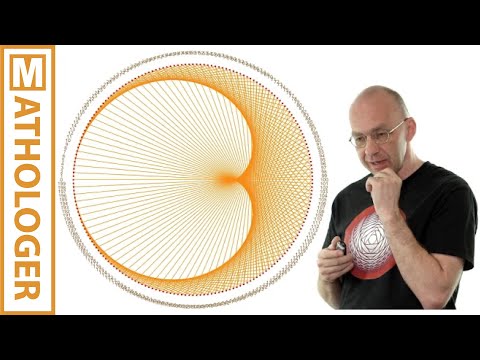
Times Tables, Mandelbrot and the Heart of Mathematics
Mathologer shows how times table diagrams on a circle produce cardioids and other curves connected to the Mandelbrot set.

Do Complex Numbers Exist?
Sabine Hossenfelder asks whether complex numbers are just a convenient tool or necessary in physics.

Cosmos - Carl Sagan - 4th Dimension
A segment from Carl Sagan's original Cosmos explaining the fourth spatial dimension through analogy with a two-dimensional world and shadow projection.
HACKENBUSH: a window to a new world of math
Owen Maitzen's animated hour-long introduction to Hackenbush, a simple combinatorial game, and how its strategy leads to surreal numbers and the roots of the number system.

1. A strange determinant
Timothy Gowers thinks aloud, in real time, as he tries to understand why Pascal's determinant equals 1.

Pi and the Mandelbrot Set - Numberphile
Numberphile with Dr Holly Krieger shows how the digits of pi surprisingly emerge from the Mandelbrot set.

Euler's formula with introductory group theory
3Blue1Brown builds intuition for Euler's formula, e^(pi i) = -1, using the core ideas of group theory.

Hamming, "n-Dimensional Space" (April 14, 1995)
Richard Hamming's 1995 lecture on n-dimensional space, showing how geometric intuition about spheres and cubes breaks down in high dimensions.

Lecture 7: Introduction to Galois Fields for the AES by Christof Paar
Christof Paar's university lecture introducing Galois fields and finite-field arithmetic as used in AES.

Infinite fractions and the most irrational number
Mathologer uses continued fractions to show why the golden ratio is the most irrational number, comparing it with root 2, e and pi and pointing to where this shows up in nature.

Hyperbolica: A Non-Euclidean Adventure [Old Trailer]
The old announcement trailer for Hyperbolica, CodeParade's Unity game set in hyperbolic and spherical space.
Lec 1 | MIT 6.042J Mathematics for Computer Science, Fall 2010
The first lecture of MIT 6.042J Mathematics for Computer Science, taught by Tom Leighton, introducing mathematical proofs.

What if Current Foundations of Mathematics are Inconsistent? | Vladimir Voevodsky
Vladimir Voevodsky's IAS lecture starts from Godel's second incompleteness theorem to explore whether first-order arithmetic could be inconsistent.

Stanford Seminar: Beyond Floating Point: Next Generation Computer Arithmetic
John Gustafson presents posits, a proposed drop-in replacement for IEEE 754 floats that is simpler in hardware and more flexible in precision.

How Many Holes Does a Human Have?
Vsauce asks how many holes a human has and uses topology to show the answer depends on what counts as a hole, with animations and expert input.

Category Theory in Life - Eugenia Cheng
Eugenia Cheng gives the opening keynote at Lambda World 2017, presenting category theory as very abstract algebra whose abstraction gives it broad applicability.

The Hyperbolic Geometry of DMT Experiences (@Harvard Science of Psychedelics Club)
Andres Gomez Emilsson of the Qualia Research Institute presents a model of DMT experiences using hyperbolic geometry and dynamical systems theory.

Category Theory by Tom LaGatta
Tom LaGatta's talk on category theory at a 2014 LispNYC meetup, covering objects, morphisms and the basic ideas in an informal, conversational style.

The Maths of General Relativity (1/8) - Spacetime and Worldlines
The first of an eight-part ScienceClic series building general relativity, covering worldlines, proper time and coordinate systems with animated visualizations.
Lecture 1 | Convex Optimization I (Stanford)
The introductory lecture of Stephen Boyd's Stanford Convex Optimization I course (EE 364A).