 PickVids
Best Recreational & visual math Videos
The 141 Recreational & visual math videos here were recommended by different people across different months. Choose by who it is for: 35 introductory, 22 intermediate, 84 for a general viewer, and 0 for someone who wants the harder derivation. Most of them are an explainer. What they share is that one picture or analogy is used to supply a missing concept. Channels you will keep seeing include 3Blue1Brown, Numberphile, Stand-up Maths.

SmoothLifeL
Tim Hutton's demonstration of SmoothLifeL, a continuous version of Conway's Game of Life using floating point values.

But what are Hamming codes? The origin of error correction
3Blue1Brown's discovery-oriented introduction to error correction codes, building up Hamming codes from the puzzle of locating a flipped bit.
How Imaginary Numbers Were Invented
Veritasium tells the history of how imaginary numbers arose from the quest for a general solution to the cubic equation, including the duels and secrecy among Renaissance mathematicians.

Infinity is bigger than you think - Numberphile
Numberphile's James Grime explains Cantor's result that some infinities are bigger than others, including why the reals outnumber the integers.
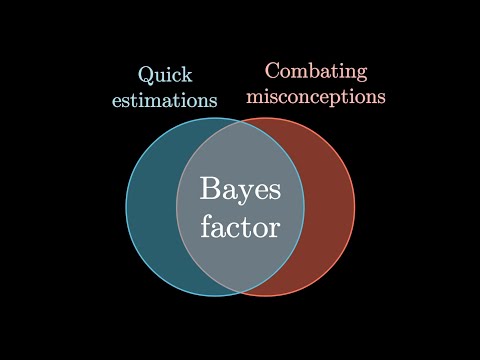
The medical test paradox, and redesigning Bayes' rule
3Blue1Brown explains why positive results on accurate medical tests are often false positives, and reframes Bayes' rule using likelihood ratios (Bayes factors) to update odds.
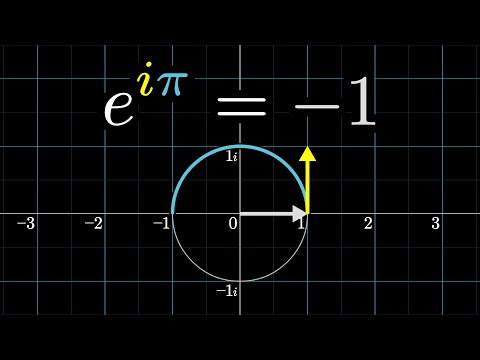
e^(iπ) in 3.14 minutes, using dynamics | DE5
A short 3Blue1Brown video explaining Euler's formula e^(i*pi) = -1 through dynamics, treating velocity as the thing that moves a point to a new position.

Four Dimensional Maths: Things to See and Hear in the Fourth Dimension - with Matt Parker
Matt Parker gives a hands-on Royal Institution talk on how four-dimensional shapes appear in a 3D world, with props like straw frames, Mobius strips and a knitted hat.

Fantastic Quaternions - Numberphile
Numberphile's James Grime introduces quaternions, a type of number beyond the complex numbers, building up from real and complex numbers and explaining why they are useful.
Pi hiding in prime regularities
3Blue1Brown shows how pi emerges from prime numbers via complex numbers and sums of squares, culminating in a formula for approximating pi.

Flaw in the Enigma Code - Numberphile
Numberphile's Dr James Grime explains the flaw in the Enigma machine, namely that a letter could never be encrypted to itself, and how that helped the Allies break the code.

Graham's Number - Numberphile
Numberphile's Tony Padilla and Matt Parker discuss Graham's number, once the largest number used in a mathematical proof, and how enormous it is.

Numberphile v. Math: the truth about 1+2+3+...=-1/12
Mathologer examines the infamous Numberphile claim that 1+2+3+...

The Zipf Mystery
Vsauce's explainer on Zipf's law, the pattern in which the frequency of a word is inversely related to its rank.

Anagrams, but where you can break apart letters: "Anagraphs"
Tom Scott-style exploration by suckerpinch (Tom7) of generalized anagrams where letters can be broken into pieces, called anagraphs, with a whimsical computational approach.

Times Tables, Mandelbrot and the Heart of Mathematics
Mathologer shows how times table diagrams on a circle produce cardioids and other curves connected to the Mandelbrot set.

Randomness is Random - Numberphile
Numberphile with Simon Pampena on how humans misunderstand randomness, including coin-flip sequences, run lengths and the gambler's fallacy.

How are holograms possible?
3Blue1Brown explains how holograms record a 3D scene on 2D film, using wave diffraction and phase.

Math Encounters -- Five Balls, Two Hands: The Patterns of Juggling -- Colin Wright (Presentation)
Mathematician Colin Wright demonstrates juggling and explains the mathematics of juggling patterns, including notation that led to new throwing patterns.

New Horizons in Music: Polyrhythms | Loop
Adam Neely's Ableton Loop 2017 talk links rhythm, pitch and synaesthesia.

How secure is 256 bit security?
3Blue1Brown illustrates how enormous the 256-bit search space is, showing how infeasible it is to find a hash or key by guessing and checking.

Cosmos - Carl Sagan - 4th Dimension
A segment from Carl Sagan's original Cosmos explaining the fourth spatial dimension through analogy with a two-dimensional world and shadow projection.
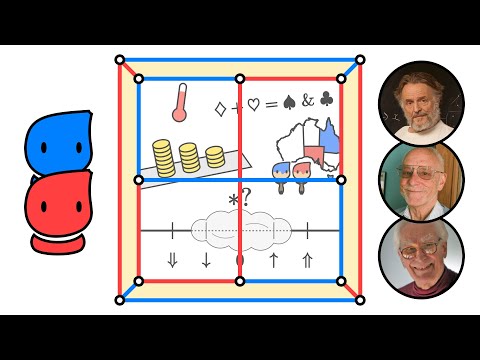
HACKENBUSH: a window to a new world of math
Owen Maitzen's animated hour-long introduction to Hackenbush, a simple combinatorial game, and how its strategy leads to surreal numbers and the roots of the number system.

1. A strange determinant
Timothy Gowers thinks aloud, in real time, as he tries to understand why Pascal's determinant equals 1.

Pi and the Mandelbrot Set - Numberphile
Numberphile with Dr Holly Krieger shows how the digits of pi surprisingly emerge from the Mandelbrot set.