 PickVids
Best Data science & statistics Videos
The 56 Data science & statistics videos here were recommended by different people across different months. Choose by who it is for: 9 introductory, 12 intermediate, 32 for a general viewer, and 3 for someone who wants the harder derivation. Most of them are a talk. What they share is that one speaker finishes a claim, and the examples exist to hold that claim up. Channels you will keep seeing include Veritasium, Enthought, Stand-up Maths.

Travis Oliphant: NumPy, SciPy, Anaconda, Python & Scientific Programming | Lex Fridman Podcast #224
Lex Fridman interviews Travis Oliphant, creator of NumPy, SciPy and Anaconda, about scientific Python and its history.

The Power of Big Data and Psychographics | 2016 Concordia Annual Summit
Alexander Nix of Cambridge Analytica presents at the 2016 Concordia Summit on using big data, psychographic profiling and behavioral microtargeting in elections.

Google Developers Day US - Theorizing from Data
Peter Norvig's 2007 Google talk on theorizing from data, covering what huge datasets can do for language understanding, translation, information extraction and inference.

Efficient Bayesian inference with Hamiltonian Monte Carlo -- Michael Betancourt (Part 1)
Michael Betancourt's lecture at MLSS Iceland 2014 on efficient Bayesian inference with Hamiltonian Monte Carlo.

Peter Norvig - The Unreasonable Effectiveness of Data
Peter Norvig's UBC distinguished lecture on how massive amounts of simple data, such as for language modeling, can yield understanding that hand-built models could not.

You've (Likely) Been Playing The Game Of Life Wrong
Veritasium explains why many real-world systems follow power laws rather than normal distributions.

Making R run Fast - Jan Vitek
Jan Vitek of Northeastern University gives a meetup talk on the challenges of making the R language run fast.

Jake Vanderplas - Statistics for Hackers - PyCon 2016.mp4
Jake Vanderplas's PyCon 2016 talk shows how sampling-based methods such as simulation, shuffling and bootstrapping make statistics intuitive.

Dance p 3 Mar09
Geoff Cumming uses a simulation to show how wildly the p value varies from one replication to the next because of sampling variability.

Introduction to Julia - Part 1 | SciPy 2014 | David Sanders
David Sanders gives the first part of a two-part introduction to the Julia programming language at SciPy 2014.

BahnMining - Pünktlichkeit ist eine Zier (David Kriesel)
David Kriesel's 36C3 talk, in German, analyzes a year of scraped data on every stop of every long-distance train in Germany.

Bringing the Unix Philosophy to Big Data by Bryan Cantrill: FutureStack13
Bryan Cantrill presents Manta, an object store with in-situ compute that lets tools like grep, awk, and sed run map-reduce style over huge data.

Cambridge Ideas - Professor Risk
David Spiegelhalter, Professor of the Public Understanding of Risk, uses statistics to weigh everyday risks such as bacon sandwiches and cycling.
What is the best diet for humans? | Eran Segal | TEDxRuppin
Prof.

Naive empiricism, terrorism & Ebola.
Nassim Taleb argues that evidence on terrorism risk presented in media is statistically naive, using extreme value theory without math to separate fat-tailed risks like Ebola and terrorism from thin-tailed ones.

The 100 Year Flood Is Not What You Think It Is (Maybe)
Practical Engineering explains what a 100-year flood actually means, combining statistics, hydrology and how society treats risk.
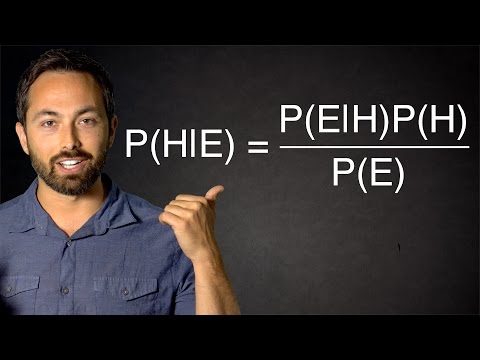
The Bayesian Trap
Veritasium explains Bayes' theorem with examples and introduces the 'Bayesian trap', where repeated events get mistaken for inevitable ones.

violin plots should not exist
Physicist Angela Collier rants for 42 minutes about why violin plots are a poor way to show data, citing papers on violin and bean plots.

Do these scatter plots reveal fraudulent vote-switching in Michigan?
Matt Parker of Stand-up Maths examines scatter plots that were claimed to show fraudulent vote-switching in Michigan's 2020 election.

Why do Biden's votes not follow Benford's Law?
Matt Parker examines claims that Biden's 2020 vote counts violate Benford's Law, explaining the law and why it often does not apply to precinct-level election data.

Protecting Privacy with MATH (Collab with the Census)
minutephysics, in collaboration with the US Census Bureau, explains differential privacy and why the 2020 census adds noise to protect individuals' data.

Clutching at Random Straws, Matt Parker | LMS Popular Lectures 2010
Matt Parker's LMS popular lecture on how seemingly incredible results can be meaningless random patterns.

Jonathan Diegelman - Modeling Spacecraft Separation Dynamics in Julia
A JuliaCon talk by a NASA Launch Services Program engineer on modeling spacecraft separation dynamics in Julia.

Foundry 2022 Operating System Demo
A 49-minute demo of Palantir Foundry by its chief architect.